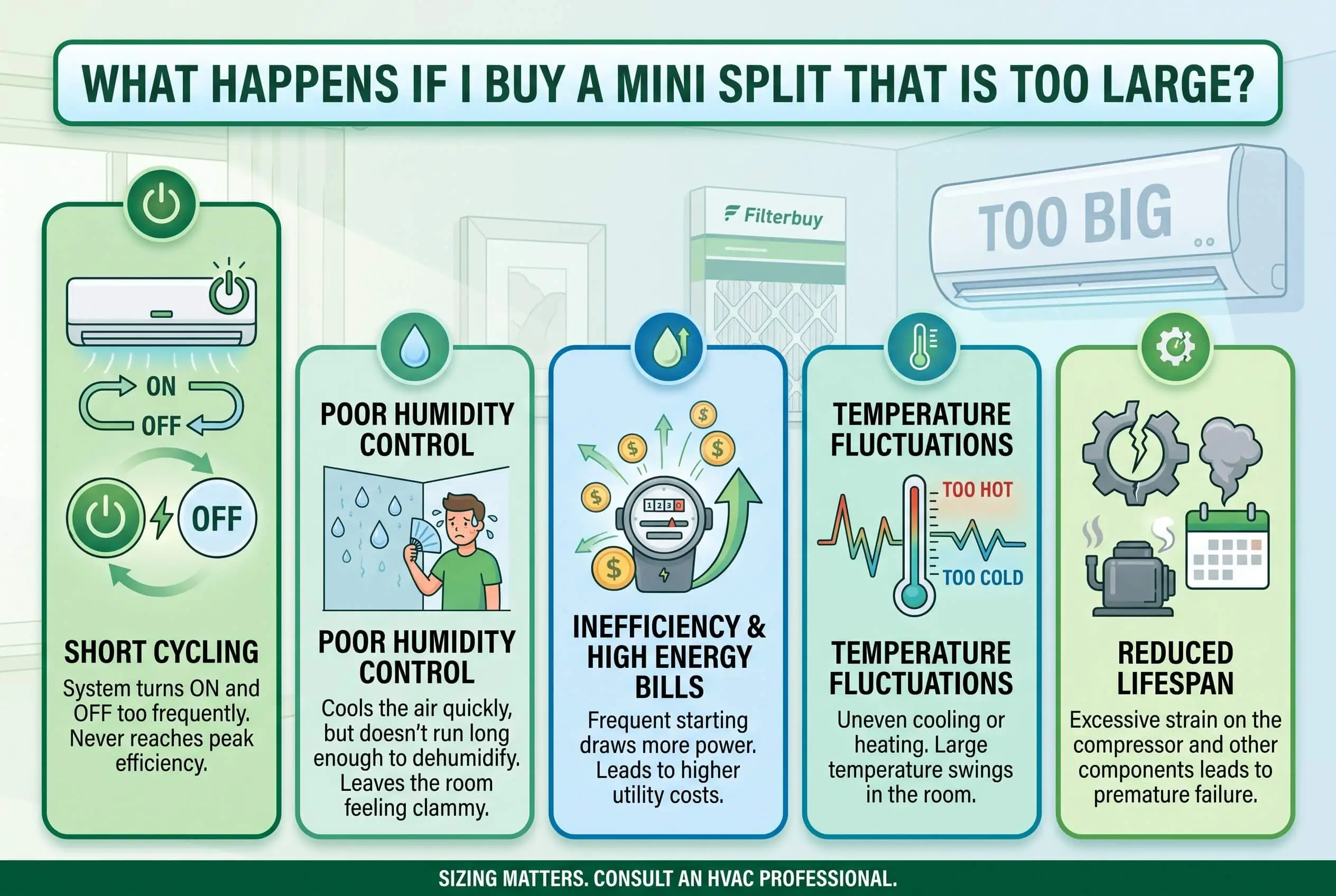
A mini split that is too large will hit your target temperature in five or six minutes, shut off, and leave you sitting in air that feels cold and damp at the same time. That short burst is the whole problem. The unit never runs long enough to pull moisture out of the room, the compressor absorbs the wear of constant starting and stopping, and the power bill climbs even though the system idles through most of the hour. I have walked into plenty of bedrooms where the thermostat reads 71 degrees and the room still feels swampy. Nine times out of ten the equipment is simply too big for the space it serves.
TL;DR Quick Answers
What size mini split do I need?
Multiply your room's square footage by 20 to 25 BTUs. A 300 square foot bedroom needs roughly 6,000 to 7,500 BTUs, not the 12,000 BTU unit most people buy. Adjust that number upward for tall ceilings, west-facing sun, thin insulation, or kitchen heat before you order anything.
Start here: room square footage times 20 to 25 BTUs
Add capacity for: ceilings over eight feet, west or south sun, weak insulation, kitchen appliances, rooms that regularly hold more than two people
Caught between two sizes: size up in hot, humid climates and size down in mild, well-insulated rooms
Oversizing costs you: too much capacity short cycles, skips dehumidification, and leaves the room cold and clammy
Confirm before ordering: ask your installer for a Manual J load calculation
Top Takeaways
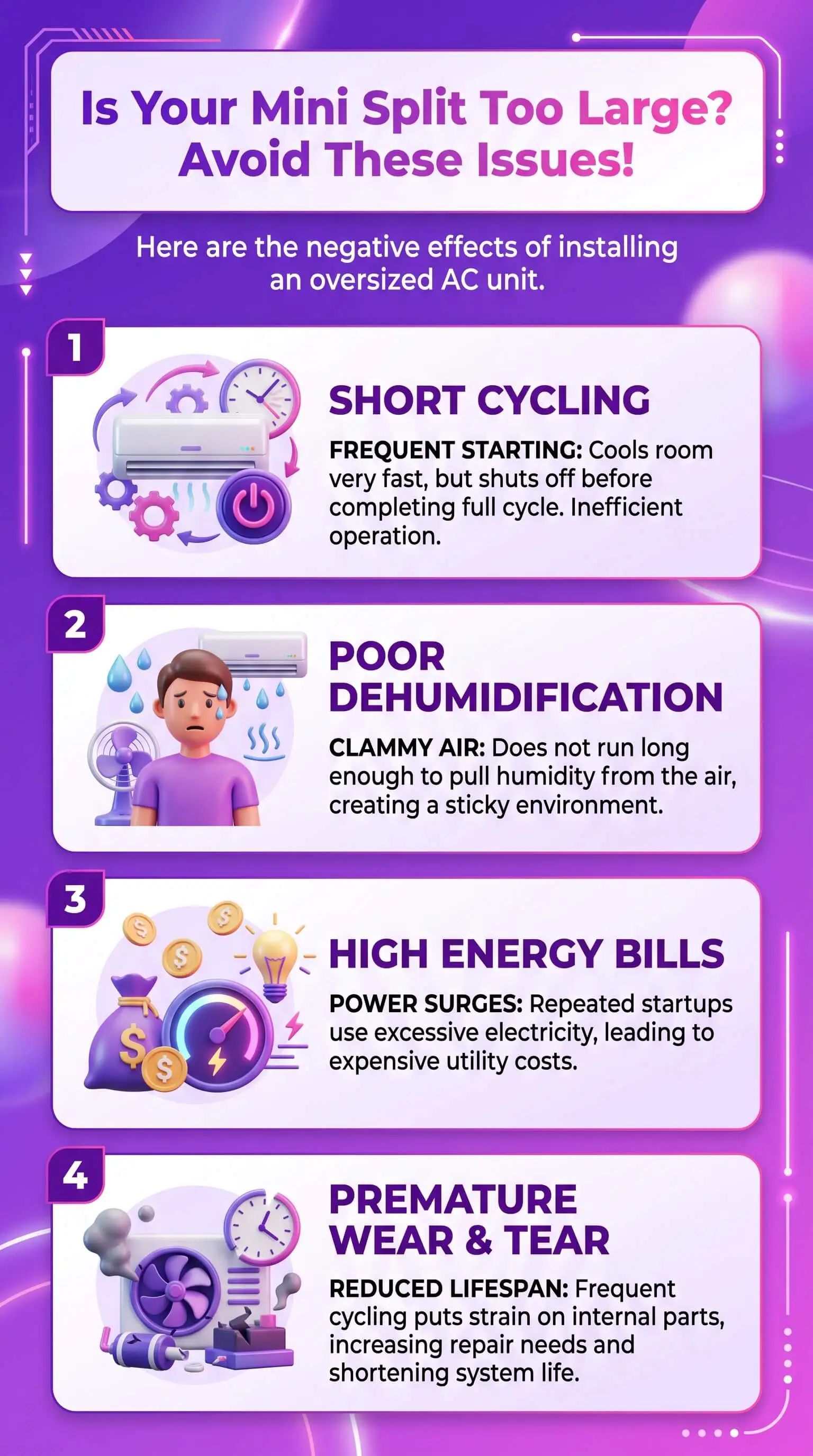
An oversized mini split short cycles, which means brief runs of five minutes or less several times an hour.
Short runs leave moisture in the room, producing air that reads cool on the thermostat and feels damp on your skin.
Frequent compressor starts drive up electricity use and shorten equipment life.
Multiply room square footage by 20 to 25 BTUs, then adjust for ceilings, sun, insulation, and appliance heat.
When your calculated number falls between two standard sizes, look at the room conditions before you round upward.
What Actually Goes Wrong When a Mini Split Is Too Large
Short Cycling and What It Does to the Compressor
An air conditioner removes heat from a room and carries it outside, which is the basic mechanism behind every system covered in the general overview of air conditioning. Moving that heat takes time. A correctly sized mini split in a bedroom runs 15 to 20 minutes at a stretch on a hot afternoon. An oversized one satisfies the setpoint in five and stops. Repeat that four or five times an hour and the compressor spends its working life in startup, which draws far more current than steady running and stresses parts built for continuous rotation.
The Humidity Problem Nobody Warns You About
Cooling does two jobs at once. It drops the air temperature, and it condenses moisture onto the indoor coil so water drains outside instead of hanging in your bedroom. That second job only happens while the coil stays cold and air keeps moving across it, and a five minute run barely gets started. The thermostat reads satisfied, the fan stops, and much of the moisture on the coil evaporates straight back into the room. High-quality pleated furnace filters help support consistent airflow across the coil, allowing the system to remove moisture more effectively. On Florida jobs I have metered rooms above 65 percent relative humidity while the wall display insisted everything was fine.
Higher Bills Even Though the System Runs Less
Most homeowners assume fewer running minutes means a smaller bill. The current spike lives in startup, so a system cycling six times an hour can pull more over a day than one running steadily through longer stretches. You also pay more up front for the larger unit. I have replaced 18,000 BTU heads with 12,000 BTU heads in single bedrooms and watched summer usage drop on the next statement.
Getting the Size Right Instead
Sizing starts with square footage. Multiply the room by 20 to 25 BTUs per square foot, then adjust upward for high ceilings, west-facing glass, thin insulation, and kitchen heat. A 300 square foot bedroom lands near 6,000 to 7,500 BTUs, which explains why the 12,000 BTU head so many people install there runs close to double what the space asks for. Run the numbers before you shop. This walkthrough of what size mini split do I need takes you through the math room by room. For whole-home capacity on a larger house, I covered the same ground in How To Choose The Right Size HVAC Unit For A 2,000 Sq Ft Home In Winter Garden FL.
"The oversized units are the ones I get called back to. Nobody complains about temperature, they complain the room feels damp, and by then the equipment has run wrong for two summers."
7 Essential Resources
Check Whether the Model You Want Is Independently Certified
ENERGY STAR Ductless Heating and Cooling lays out certification criteria and includes a proper sizing section that names the calculation your contractor should be performing.
See the Load Calculation Your Installer Should Be Running
ACCA Manual J Residential Load Calculation is the recognized national standard for residential sizing loads, and building codes in most jurisdictions require it.
Read the Industry Warning About Oversized Equipment
AHRI guidance on air conditioners and heat pumps states plainly that an oversized system cycles too frequently and loses its ability to control humidity.
Learn the Humidity Range That Keeps Mold Out of Your Walls
A Brief Guide to Mold, Moisture and Your Home from the EPA covers the moisture thresholds that decide whether a damp room becomes a mold problem.
Find Out When Damp Air Turns Into a Health Issue
CDC guidance on mold explains the symptoms that show up in damp housing and the humidity ceiling worth holding all day.
Look at What Happens When a Whole Region Sizes Ductless Properly
The NEEA Ductless Heat Pump project documents more than 150,000 Northwest installations and the contractor training that made correct sizing routine.
Hire a Technician Who Has Been Tested on Sizing and Installation
NATE certification for homeowners covers what the credential actually verifies and how to confirm the tech showing up at your door holds it.
These trusted resources explain how proper mini split sizing, professional load calculations, and why correctly sized air conditioners control humidity all work together to improve comfort, efficiency, and indoor air quality.
3 Statistics
Air conditioning consumed about 19 percent of all electricity used in United States homes in 2020, roughly 254 billion kilowatthours. Every wasted cycle comes out of a very large pool of household spending. Source: U.S. Energy Information Administration.
Traditional heat pumps and air conditioners run a sensible heat ratio around 0.75, and newer high-efficiency ductless models trend higher, which means weaker dehumidification. Oversizing stacks a second moisture penalty on equipment that already dehumidifies less than the systems it replaces. Source: Building America Solution Center, Pacific Northwest National Laboratory.
The median single-family home completed in 2024 measured 2,146 square feet. That whole-house figure tells you nothing about the 12 by 14 bedroom you are actually cooling, and ductless sizing happens one room at a time. Source: U.S. Census Bureau.
These statistics show why accurate mini split sizing matters for comfort, energy use, and humidity control, while pairing a properly sized system with top air filters helps support efficient airflow and overall HVAC performance.
Final Thoughts and Opinion
After years of service calls, my honest position is that oversizing costs homeowners more than undersizing does. An undersized unit announces itself. The room stays hot, you call somebody, and the problem gets solved in a season. An oversized unit hides. It holds temperature well enough that nobody suspects the equipment, so families live with clammy air, musty closets, and a compressor grinding toward early failure for years. Proper AC installation and correct system sizing help prevent these hidden problems from developing in the first place. Bigger feels like insurance in the showroom. It behaves more like a slow leak.
Frequently Asked Questions
Is it better to oversize or undersize a mini split?
Neither works well, though undersizing usually causes less lasting damage. An undersized unit runs constantly and struggles on peak days. An oversized unit short cycles, leaves humidity behind, and wears the compressor out early. Match the calculated load as closely as available equipment tiers allow.
Can an oversized mini split be fixed without replacing it?
Sometimes you can improve it. Many inverter models let you cap capacity, and dry mode extends cycle length in humid weather. A room dehumidifier handles leftover moisture. None of that fully corrects a head twice the size the room needs.
How many BTUs per square foot does a mini split need?
Plan on 20 to 25 BTUs per square foot. Use the lower figure for well-insulated rooms in mild climates and the higher figure for sun-exposed rooms in hot, humid regions. Add capacity for ceilings above eight feet and for kitchen appliance heat.
Does an inverter mini split solve the oversizing problem?
It reduces the damage without eliminating it. Inverter compressors modulate down toward a fraction of rated capacity, so cycling gets less brutal than it would be on a single-stage system. Every unit still has a minimum output, and a badly oversized head will drop below it and cycle anyway.
How do I tell whether short cycling is a sizing problem or something else?
Time the runs on a hot afternoon with the doors closed. Cycles under seven minutes on a design day point toward oversizing. Cycles that shorten suddenly on equipment that behaved normally last summer point toward a dirty filter, low refrigerant charge, or a fouled coil instead. If you feel allergic to the air conditioner at the same time indoor comfort changes, correcting the underlying system issue may also help improve air quality and humidity control.
Buying a mini split that is too large costs you comfort every day you own the system. Measure the room, run the BTU math, and buy to the number you calculate. Pairing the correctly sized system with a MERV 8 pleated HVAC air filter also helps support efficient airflow and consistent overall performance.